Prison Planet
The Shared Insanity
© 2026 AD INGENIUM LLC. All rights reserved.
The modern 8-hour, 5-day workweek is increasingly biologically incompatible, economically unnecessary & inefficient, and socially harmful. Despite extraordinary productivity gains and emerging AI/automation capabilities, society clings to an industrial-era model influenced by an outdated Puritan work ethic and deliberate actions of entitled and rapacious elites. This article proposes a societal reset toward a healthier, more efficient, and more fulfilling balance between work, leisure, exercise, and reflection. It explores lessons from historical experiments, forecasts GDP and quality-of-life impacts, outlines global steps necessary for transformation.
If a non-terrestrial probe came into Earth’s orbit to observe our planet they would likely report back the following items:
1. It must be a penal colony type planet where the vast majority of intelligent inhabitants, homo sapiens, live in poor conditions; made to toil when there’s clearly technologies and operations constructs that would not require it; and those prison planet operations are managed by a few handfuls of well off wardens who’ve convinced and maintain the misbeliefs of these wretched prisoners that this is only way their lives can exist.
2. The planet is managed in such a way to enhance violence at all scales, local, regional, and global serving a range of purposes:
a. Perverse self-enrichment for the planet’s wardens.
b. A means to preoccupy and reduce the prisoner’s own self-awareness preventing them from easily and radically changing their own circumstances for the better.
c. Wanton disregard for all other species of life organisms on the planet other than homo sapiens. Creating constant imbalances between consumption and available resources leading to conflicts over mismanaged and therefore, in many cases, dwindling supplies.
The alien probe would report these conclusions because the current operations, the socioeconomics, of the prisoners are vastly incongruent with the technologies, resources, and economic capabilities they possess which would allow them to have a vastly more leisurely, healthy, rich and fulfilling lives. Oddly, this incoherent existence seems almost self-imposed with the wardens controlling the whole system, not by force mostly, but by perpetuating egregious belief systems.
In order to understand this logical conclusion by the alien probe we have to walk through how society has gotten to its current state.
The Road to Hell is paved with mostly Good Intentions, at least In the Beginning
Religious leaders in medieval and early modern Europe taught that life on Earth was meant to be difficult as part of a divine test. Suffering was seen as spiritually purifying and rewarded with eternal happiness in heaven. This belief reinforced social hierarchies, provided hope in hopeless conditions, and promoted obedience and patience among peasants. Labor was framed as a moral duty and idleness as sin (17th-century Puritanism) [To be fair modern religions have largely shifted away from those roles and beliefs]. Early capitalists and elites leveraged and reinforced long work hours to maximize profits and control social behavior. The extent that industrialization reduced leisure is rather shocking:
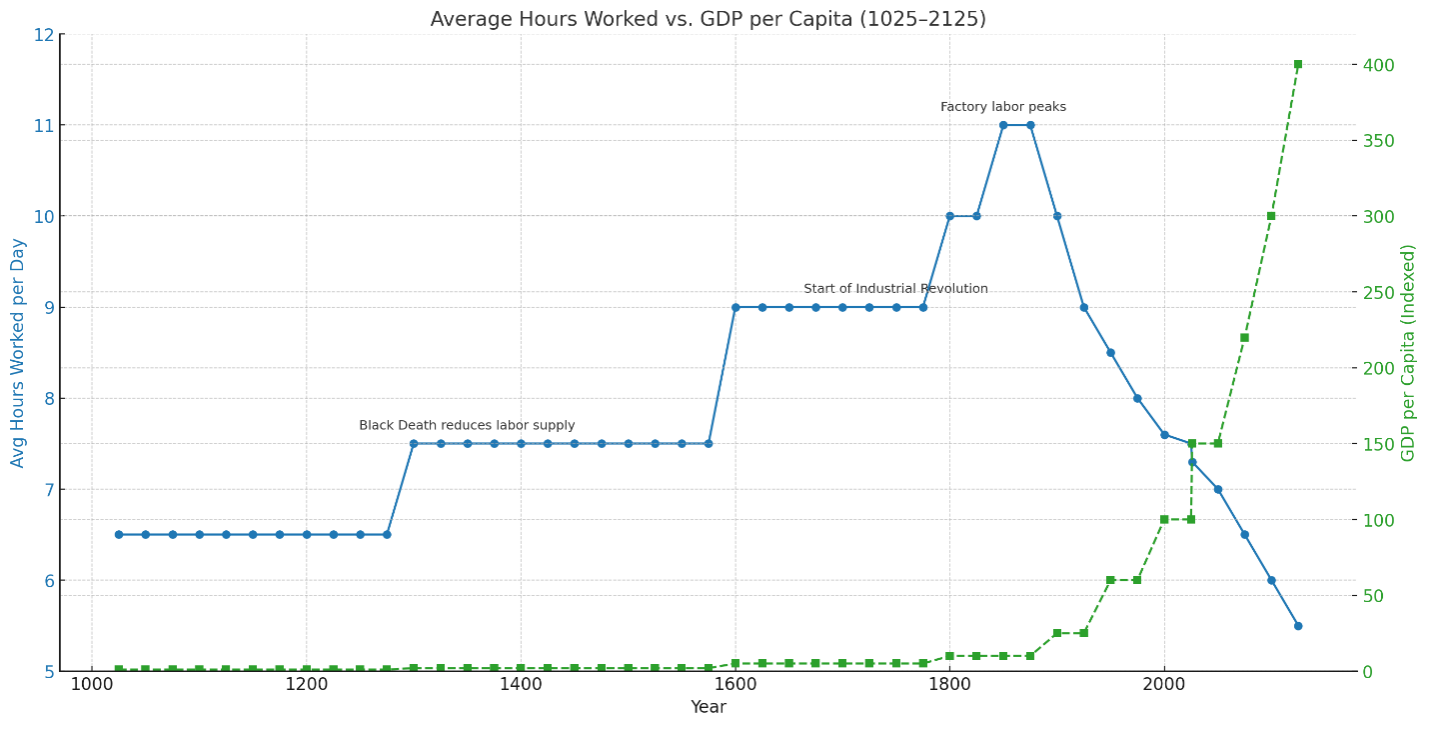
We have less leisure than we had 1000 years ago…
Now there’s a range of reasons for that:
Medieval Europe was primarily an agricultural society. The intensity of labor varied significantly throughout the year based on seasonal cycles. During periods of planting and harvest, labor demands were high. However, long stretches of the calendar—particularly during winter and midsummer—were marked by low agricultural activity. Without artificial lighting or mechanized tools, labor was also constrained by natural daylight, limiting the effective length of the workday. This agricultural seasonality naturally resulted in a lower average of work hours across the entire year.
The Roman Catholic Church played a central role in daily life and effectively structured the labor calendar around numerous religious observances. These included feast days, saints' days, and church-mandated holidays. Historians estimate that medieval peasants might have had up to 150 or more days per year free from labor due to religious observances. As Juliet Schor notes in The Overworked American, these rest days significantly contributed to a lower annual workload compared to both industrial and post-industrial societies.
Economic motivation to maximize working hours was minimal in a feudal or manorial economy. Most peasants worked land in exchange for protection and access, rather than wages. Surplus production often benefited the landowning class rather than the laborer, diminishing the incentive to work beyond subsistence. Labor was focused on fulfilling basic survival needs rather than generating profit or capital accumulation. The notion of fixed work schedules and punctuality tied to a clock—the hallmarks of industrial labor—did not exist in the early medieval period. Historian E.P. Thompson, in his seminal essay Time, Work-Discipline, and Industrial Capitalism, emphasizes that time-conscious labor only emerged with the development of factory systems in the 18th and 19th centuries. In the medieval context, labor patterns were fluid, tied to nature and ritual rather than mechanical timekeeping.
To be honest I can’t imagine working an 11-hour shift in late 1800’s early 1900’s factory. I would imagine people must of walked out of those industrial factories shell shocked at the end of their shift. Without union protection imagine the noise, the dirt, poor lighting & ventilation, insufficient breaks! 8-hour workdays were achieved after labor struggles. Henry Ford (1926) standardized the 5 day, 40-hour workweek to boost both productivity and consumption of his own products (ofcourse – no altruism there).
Despite automation, corporate and political elites blocked further reductions to sustain consumer demand and worker discipline. There are benefits of greater GDP, but they are disproportionately better for the owners of capital than for laborers.
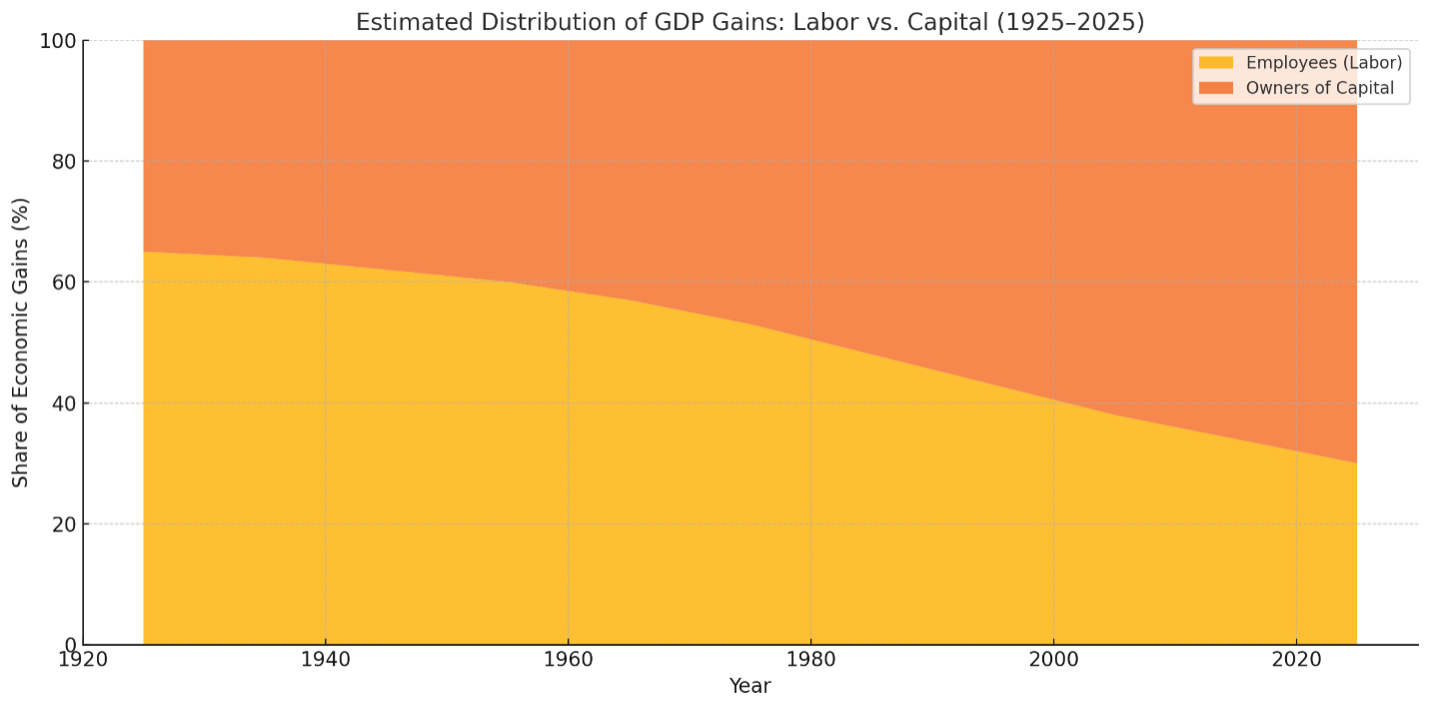
Who made the deal that improvements in productivity would only be used to generate more profits & greater consumption vs. reducing work hours?? No one did. There’s been no debates, no consensus, no broad social, cultural, and humane considerations – just the relentless market forces with limited constraints. The elite, the owners of capital have made sure of that…
It is worth recognizing that Newton’s First Law of Motion has also played a key role here. It states that an object in motion will stay in motion with the same speed and in the same direction unless acted upon by an unbalanced force. This is not only true for physical objects, but for cognitive, social, and cultural ones as well. Over time these unchallenged dynamics become logical expectations,
“traditions” in their own right. History has taught us that overcoming traditions can be a very long, challenging, and perilous undertaking.
It is time for the unbalanced force to destroy our self-imposed global prison. To step outside of our traditional work dynamics and see it for what it is. It is time to redesign it commensurate with the state-of-the-art technologies available, not to increase consumption of the planet, but to increase leisure, to increase the quality of life for our workforces, and to rebalance resource demands into a sustainable balance with the planet.
The first step is to recognize that humans are not machines, no matter how much owners of capital would like to treat them that way. Humans are not meant to be run continuously on the same task non-stop for multiple hours at a time. We need a new model of Optimized Work-Life Balance.
Based on human Ultradian [Ultradian refers to a biological rhythm that repeats more than once within a 24-hour day (i.e., shorter than a circadian rhythm)]. cycle research to maximize performance and well-being, human workdays should be structured around 90-minute work sessions with 15–30 minutes breaks, limiting total deep work to 3–4 cycles per day. This approach reflects the body’s natural rhythms and outperforms traditional 8-hour models in both efficiency and sustainability.

In the short-term these adaptations would have a 5-10% dip in GDP, but in the long-term given the improved human performance and health it is projected to have higher innovation, entrepreneurship, lower healthcare costs stabilizing or even enhancing GDP.
Experiments in reduced workweeks have been conducted in several countries:

Taking these steps would also reduce the growing misalignment with current and evolving capabilities:
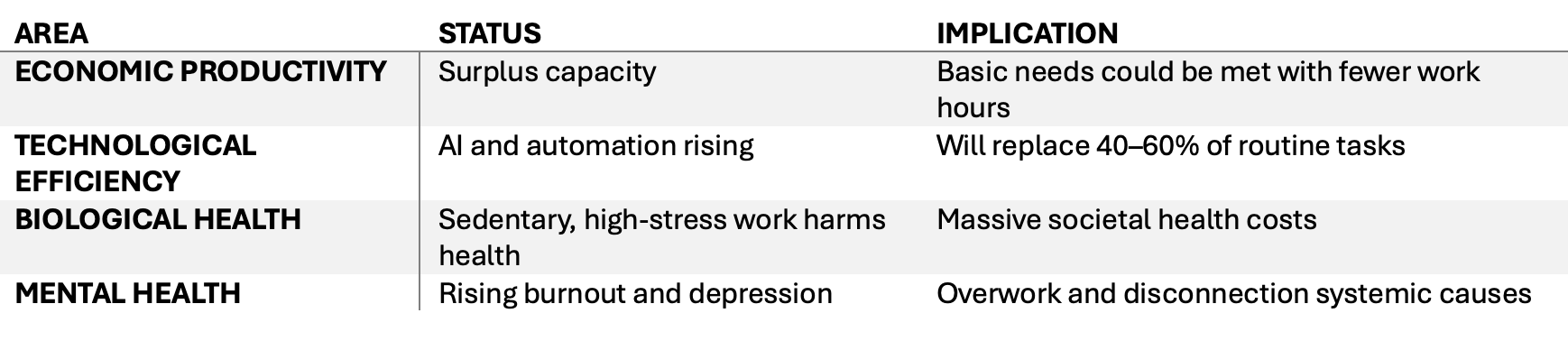
In order to both increase the probability of success and speed up the transitions in peaceful ways as possible global efforts should be undertaken now. Historically humanity has not done well with large changes in socioeconomics and/or associated technologies:
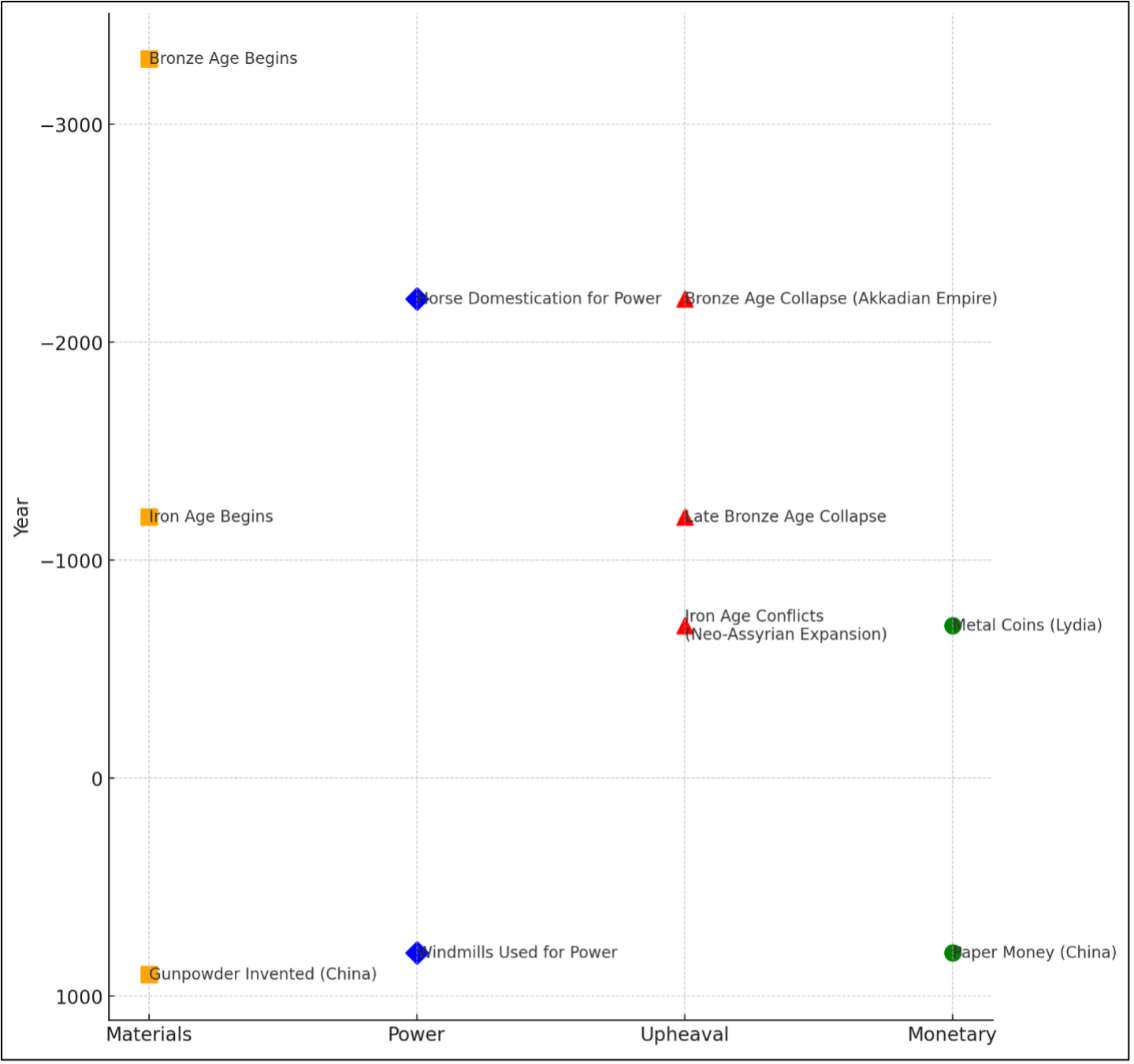
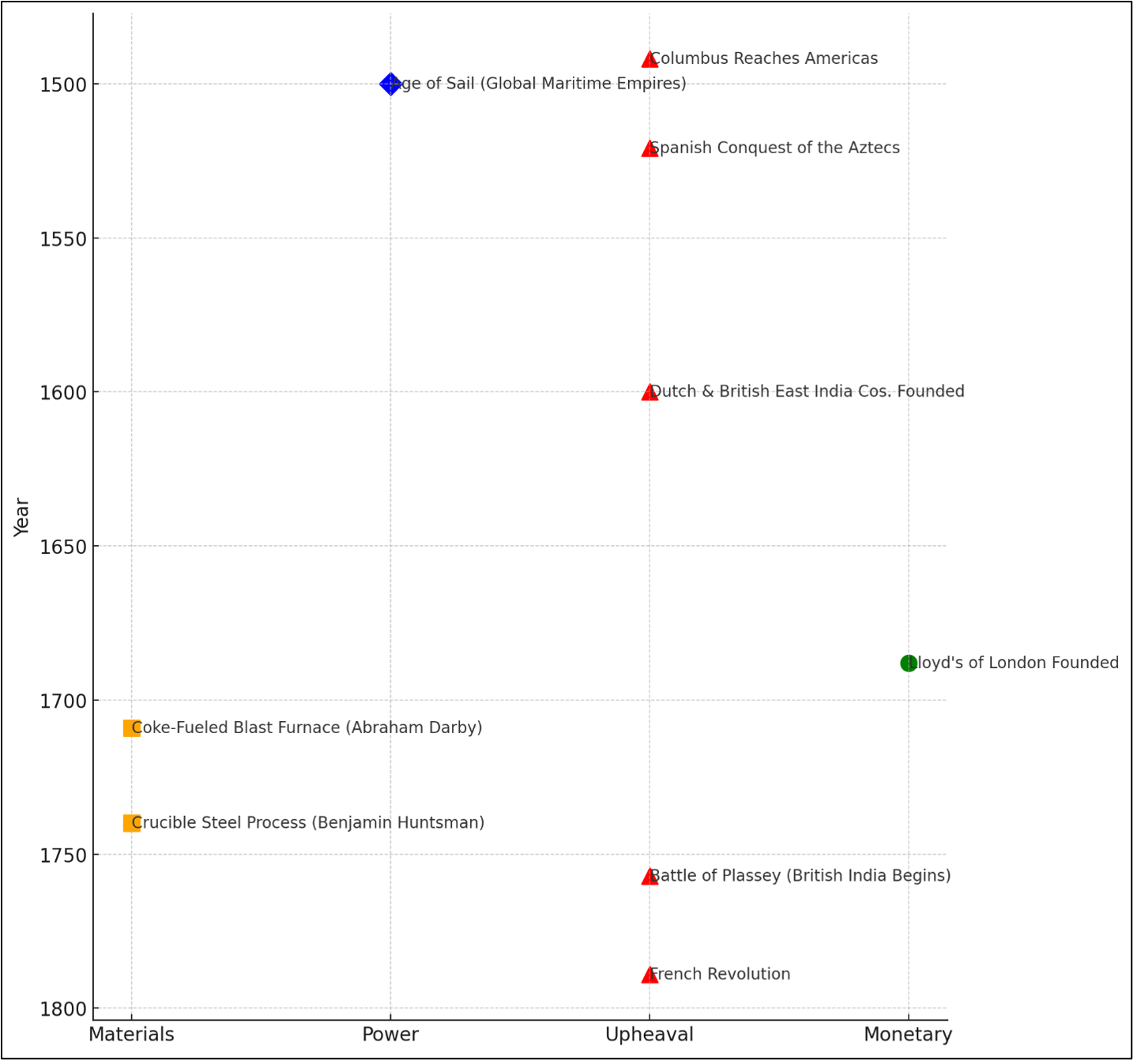
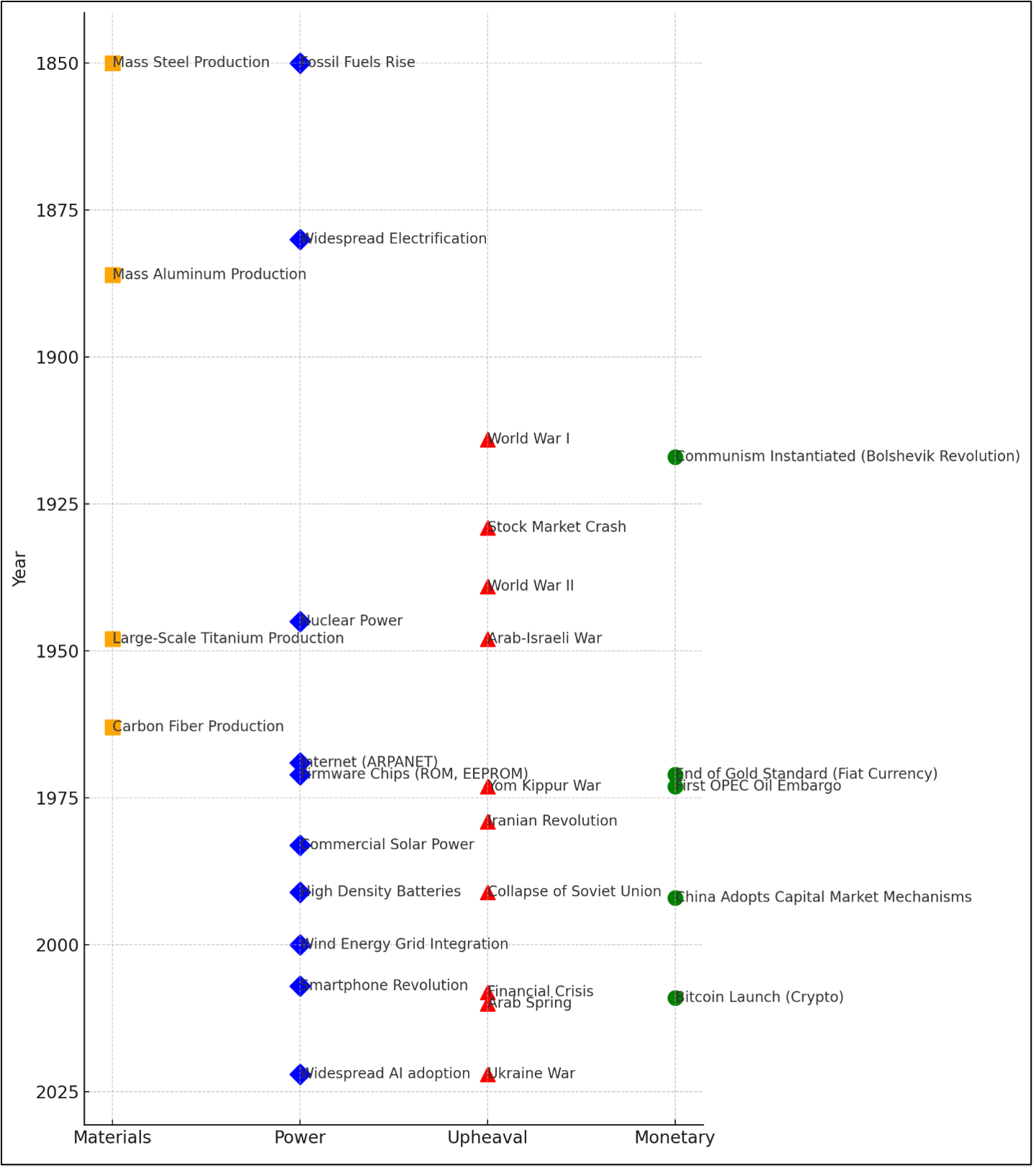
Throughout history, technological and systemic transitions — in money, materials, or power sources — have consistently triggered inequality spikes, mass migration, and violent upheavals. Transitions can destabilize societies when new systems undermine existing elites or resources balances.
The adoption of coal and steam played into the conditions for imperial expansion and two World Wars.
Oil geopolitics shaped conflicts from the Gulf Wars to contemporary tensions in the Middle East.
More recently, the digital disruption of information flows contributed to the Arab Spring and electoral instability across democracies (Harari, 21 Lessons for the 21st Century).
These shifts, while often enhancing long-term productivity and quality of life, also disrupt established orders and displace those unable to adapt quickly. Without proactive forethought and preparation, we could easily collapse into societal upheavals and global economic and military wars in the transition to more viable, sustainable, and higher quality of life phase of our civilization.
Recommend Global Steps for Transition
I. Cultural Reset
Redefine success around contribution and fulfillment.
Break lingering myths glorifying overwork.
II. Policy Changes
Lobby, elect, generate international agreements on shorter standard workweeks.
Expand universal healthcare and social safety nets.
III. Technological and Economic Alignment
Redirect automation gains into public good funding.
Support lifelong learning and skill development.
IV. Civic Infrastructure
Expand green spaces, libraries, and community centers.
Foster local civic engagement.
V. Opportunity Cost of Inaction: A Self-Imposed Prison
Without reform:
Rising inequality, burnout, ecological collapse, and wasted innovation.
Humanity risks imprisoning itself within a scarcity mindset despite technological abundance.
Earth risks becoming a self-imposed labor camp rather than a flourishing civilization.
References:
Core Historical and Economic Works
Basalla, George. The Evolution of Technology. Cambridge: Cambridge University Press, 1988.
Diamond, Jared. Guns, Germs, and Steel: The Fates of Human Societies. New York: W.W. Norton & Company, 1997.
Ferguson, Niall. The Ascent of Money: A Financial History of the World. New York: Penguin Books, 2008.
Gordon, Robert J. The Rise and Fall of American Growth: The U.S. Standard of Living since the Civil War. Princeton: Princeton University Press, 2016.
Graeber, David. Debt: The First 5000 Years. Brooklyn: Melville House, 2011.
Harari, Yuval Noah. Sapiens: A Brief History of Humankind. New York: Harper, 2015.
Landes, David S. The Wealth and Poverty of Nations: Why Some Are So Rich and Some So Poor. New York: W.W. Norton & Company, 1998.
McNeill, William H. The Pursuit of Power: Technology, Armed Force, and Society since A.D. 1000. Chicago: University of Chicago Press, 1982.
Mokyr, Joel. The Lever of Riches: Technological Creativity and Economic Progress. Oxford: Oxford University Press, 1990.
Neal, Larry. The Rise of Financial Capitalism: International Capital Markets in the Age of Reason. Cambridge: Cambridge University Press, 1993.
Pacey, Arnold. Technology in World Civilization: A Thousand-Year History. Cambridge: MIT Press, 1990.
Perez, Carlota. Technological Revolutions and Financial Capital: The Dynamics of Bubbles and Golden Ages. Cheltenham: Edward Elgar Publishing, 2002.
Piketty, Thomas. Capital in the Twenty-First Century. Cambridge: Harvard University Press, 2014.
Pipes, Richard. The Russian Revolution. New York: Knopf, 1990.
Service, Robert. A History of Modern Russia: From Nicholas II to Vladimir Putin. Cambridge: Harvard University Press, 2009.
Smil, Vaclav. Energy and Civilization: A History. Cambridge: MIT Press, 2017.
Smil, Vaclav. Power Density: A Key to Understanding Energy Sources and Uses. Cambridge: MIT Press, 2015.
Turchin, Peter. War and Peace and War: The Rise and Fall of Empires. New York: Plume, 2007.
Technology and Energy-Specific References
Gellately, Robert, ed. The Oxford Handbook of the History of Communism. Oxford: Oxford University Press, 2014.
Rhodes, Richard. Energy: A Human History. New York: Simon & Schuster, 2018.
Goodenough, John B., and Kyu-Sung Park. “The Li-Ion Rechargeable Battery: A Perspective.” Journal of the American Chemical Society 135, no. 4 (2013): 1167–1176.
Sze, S. M., and Kwok K. Ng. Physics of Semiconductor Devices. 3rd ed. Hoboken: Wiley-Interscience, 2006.
Reports and Data Sources
National Science Foundation. National Patterns of R&D Resources. https://ncses.nsf.gov/pubs.
U.S. Office of Management and Budget. Historical Tables, Budget of the United States Government. https://www.whitehouse.gov/omb/historical-tables/.
Reference Works and Encyclopedias
Encyclopædia Britannica. “Gunpowder.” Accessed May 2025. https://www.britannica.com/technology/gunpowder.
Encyclopædia Britannica. “Horse.” Accessed May 2025. https://www.britannica.com/animal/horse.
Encyclopædia Britannica. “Windmill.” Accessed May 2025. https://www.britannica.com/technology/windmill.
Encyclopædia Britannica. “Lloyd’s of London.” Accessed May 2025. https://www.britannica.com/topic/Lloyds-of-London.
Encyclopædia Britannica. “Solar Power.” Accessed May 2025. https://www.britannica.com/science/solar-power.
Encyclopædia Britannica. “Battery.” Accessed May 2025. https://www.britannica.com/technology/battery-electronics.
Encyclopædia Britannica. “Firmware.” Accessed May 2025. https://www.britannica.com/technology/firmware.
Core Ultradian Rhythm & Sleep-Cycle Research
Kleitman, N. (1963).
Sleep and Wakefulness. University of Chicago Press.Introduced the Basic Rest–Activity Cycle (BRAC): ~90-minute oscillations governing alertness, fatigue, and performance—day and night.
This is the foundational source for ultradian theory.
Lavie, P. (1985).
Ultradian rhythms in vigilance and performance.
Biological Psychology, 20(1), 17–31.Demonstrates cyclical peaks and troughs in attention and cognitive performance throughout the day.
Achermann, P., & Borbély, A. A. (1994).
Simulation of human sleep: Ultradian dynamics of electroencephalographic slow-wave activity.
Journal of Biological Rhythms.Shows physiological evidence that ultradian rhythms are hard-wired, not behavioral preferences.
Cognitive Performance, Focus, and Work–Rest Cycles
Ericsson, K. A., Krampe, R. T., & Tesch-Römer, C. (1993).
The role of deliberate practice in the acquisition of expert performance.
Psychological Review, 100(3), 363–406.Found that top performers rarely exceed 3–5 hours of true “deep work” per day, usually broken into intense sessions with rest.
Baumeister, R. F., et al. (1998).
Ego depletion: Is the active self a limited resource?
Journal of Personality and Social Psychology.Demonstrates cognitive fatigue and diminishing returns from sustained mental effort without recovery.
Ariga, A., & Lleras, A. (2011).
Brief and rare mental “breaks” keep you focused.
Cognition, 118(3), 439–443.Empirically shows that short breaks restore attention and prevent performance decline.
Workday Structure & Sustainability
Pencavel, J. (2014).
The productivity of working hours.
Economic Journal, 125(589).Found that productivity drops sharply beyond ~6 hours/day, with long hours producing more errors, not more output.
Hunnicutt, B. K. (1988).
Work Without End: Abandoning Shorter Hours for the Right to Work.Documents how the 8-hour workday is a social construct, not a biological or efficiency optimum.
Rock, D. (2009).
Your Brain at Work. HarperBusiness.Integrates neuroscience with organizational performance; argues that continuous work violates neural energy constraints.
Modern Syntheses (Popular but Evidence-Based)
Schwartz, T., & McCarthy, C. (2007).
Manage Your Energy, Not Your Time.
Harvard Business Review.Applies ultradian research to workplace design; advocates 90-minute work pulses with recovery.
Medina, J. (2008).
Brain Rules. Pear Press.Summarizes neuroscience showing humans cannot maintain peak focus for extended, uninterrupted periods